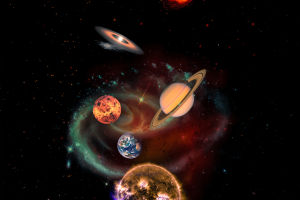
Imagine standing on Jupiter as powerful jet streams race across the sky, or watching Neptune’s winds move faster than the speed of sound on Earth.
Even without weather stations, scientists can measure these distant winds with impressive accuracy.
They do this by tracking clouds, studying light, and analyzing atmospheric data collected through advanced technology. By combining telescopic observations, spectroscopy, and physics, scientists can estimate wind speeds on distant worlds without ever traveling there. These methods reveal how planetary atmospheres work and help researchers understand worlds beyond our own.
Following Clouds Across Alien Skies
One of the oldest and most reliable methods of measuring planetary winds is observing cloud movement.
Large planets with thick atmospheres display cloud bands, storms, and swirling features that can remain visible for long periods. By capturing detailed images at carefully timed intervals, scientists can measure how far cloud patterns move and calculate wind speeds based on the distance traveled over time.
This cloud-tracking method has provided important information about atmospheric circulation on distant planets. Modern observations continue improving scientists’ understanding of how winds move across different layers of planetary atmospheres.
However, this technique works best when cloud formations remain stable enough to follow accurately.
Using Light to Measure Atmospheric Motion
Clouds reveal only part of a planet’s weather system. To study atmospheric movement that cannot be seen directly, scientists use spectroscopy.
Every chemical element and molecule interacts with light in a unique way. When atmospheric gases move toward an observer, their light patterns shift slightly in one direction. When they move away, the patterns shift in the opposite direction.
This effect, known as the Doppler effect, allows scientists to determine the speed and direction of atmospheric motion. By studying gases such as methane, hydrogen, and ammonia, researchers can create detailed maps of planetary winds and examine different atmospheric layers.
Because various gases exist at different heights, spectroscopy provides information that ordinary images cannot reveal.
Looking Beneath the Clouds with Radio Waves
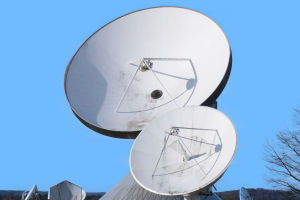
Visible light cannot pass through the thick cloud layers surrounding many giant planets. However, radio waves and microwaves can travel much deeper into planetary atmospheres.
By studying these signals, scientists can examine temperature differences and atmospheric structures hidden below visible clouds. These temperature variations influence circulation patterns by affecting how gases move throughout an atmosphere.
Deep atmospheric observations have shown that giant planets contain complex wind systems extending far below their visible cloud layers. These discoveries have improved understanding of how planets transport heat and energy.
Direct Measurements from Atmospheric Probes
Although remote observations provide valuable information, direct measurements can offer detailed insights when exploration missions are possible.
Atmospheric probes can collect information about pressure, temperature, chemical composition, and wind speeds while traveling through a planet’s atmosphere. These measurements help scientists understand conditions beneath visible cloud layers and reveal how planetary atmospheres operate internally.
Future exploration efforts may provide additional direct measurements of distant worlds, allowing researchers to study atmospheric systems in even greater detail.
Measuring Winds Without Seeing the Planet
Scientists can also study planetary weather through indirect methods when direct observation is difficult.
One technique involves observing how starlight changes as it passes through a planet’s atmosphere. When a planet moves in front of a distant star, its atmosphere affects the light passing through it. By analyzing these changes, researchers can determine atmospheric properties such as temperature and density at different heights.
Using principles of atmospheric physics, scientists can estimate wind patterns and circulation systems. This approach provides valuable information about planets that are challenging to study through direct observation.
Why Studying Planetary Winds Matters
Understanding planetary winds helps scientists learn more than just weather patterns. Atmospheric circulation affects heat distribution, chemical movement, storm development, and the overall evolution of planetary environments.
These observations improve scientific models of how planets form, change, and interact with their surroundings. The same techniques used to study nearby planets are also helping researchers explore distant worlds beyond our Solar System.
Each improvement in atmospheric measurement brings scientists closer to understanding planets that may never be visited directly.
Exploring the Hidden Weather of Other Worlds
Although no weather stations exist on distant planets, scientists have developed highly accurate methods for studying their atmospheric winds.
By tracking cloud movements, analyzing changes in light, observing radio signals, and studying atmospheric conditions through advanced techniques, researchers continue uncovering the hidden patterns of weather systems across the universe.